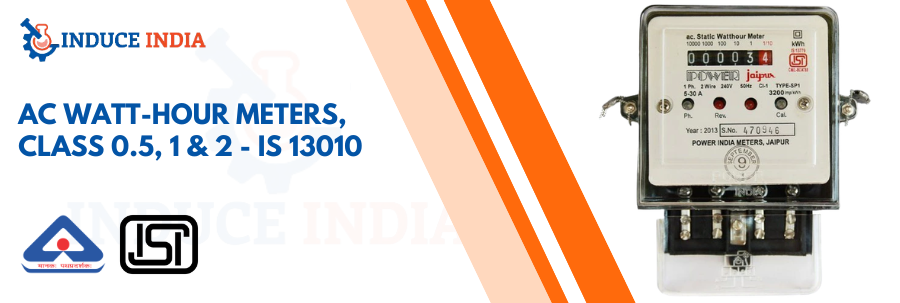
Electricity meters play a crucial role in measuring power consumption accurately in residential, commercial, and industrial applications. To ensure precision, reliability, and consumer safety, the Bureau of Indian Standards (BIS) has specified requirements under IS 13779 for AC Static Watt-Hour Meters of Class 1 and Class 2.
These meters are widely used by electricity distribution companies (DISCOMs), industries, commercial establishments, and residential consumers for accurate energy billing and monitoring.
What is IS 13779?
IS 13779 is an Indian Standard that specifies the requirements, testing methods, accuracy limits, and performance criteria for AC static watt-hour meters of Class 1 and Class 2. The standard applies to both single-phase and three-phase meters used for measuring alternating-current electrical active energy in the frequency range of 45 Hz to 55 Hz.
The standard covers:
- Meter construction requirements
- Accuracy and performance standards
- Safety provisions
- Climatic and environmental testing
- Electromagnetic compatibility
- Insulation and high-voltage tests
What are AC Static Watt-Hour Meters?
AC static watt-hour meters are electronic energy meters used to measure electricity consumption digitally. Unlike traditional electromechanical meters, static meters use electronic components for higher accuracy and tamper resistance.
These meters are commonly installed in:
- Residential buildings
- Commercial complexes
- Industrial facilities
- Utility power distribution systems
Difference Between Class 1 and Class 2 Meters
The primary difference lies in the permissible error limit during energy measurement.
| Meter Class | Accuracy Limit |
| Class 1 | ±1% |
| Class 2 | ±2% |
Class 1 meters offer higher accuracy and are generally preferred for commercial and industrial billing applications, while Class 2 meters are commonly used in residential setups.
Scope of IS 13779
IS 13779 applies to:
- Single-phase static watt-hour meters
- Three-phase static watt-hour meters
- Balanced and unbalanced load systems
- Direct-connected and transformer-operated meters
- Indoor and outdoor applications
- Multi-rate tariff meters
- Bidirectional energy measurement meters
However, the standard does not apply to:
- Portable meters
- Meters exceeding 600V line-to-line voltage
- Certain smart meter interface systems covered under other standards such as IS 16444.
Key Requirements Under IS 13779
1. Accuracy Requirements
The standard specifies strict limits of error under varying voltage, load, frequency, and temperature conditions to ensure reliable billing.
2. Electrical Requirements
Meters must perform effectively within specified:
- Voltage ranges
- Current ranges
- Frequency ranges
- Power factor conditions
3. Insulation and High Voltage Protection
Meters are tested for insulation resistance and high-voltage endurance to ensure electrical safety during operation.
4. Climatic and Environmental Testing
Meters are tested against:
- Heat
- Humidity
- Dust
- Pollution
- Temperature fluctuations
This ensures long-term reliability in Indian environmental conditions.
5. Electromagnetic Compatibility (EMC)
The standard includes EMC testing to ensure that the meter functions correctly without interference from external electromagnetic disturbances.
6. Tamper Resistance
Modern static meters under IS 13779 are designed with tamper detection and anti-theft features to prevent manipulation and energy theft.
BIS Certification for IS 13779
BIS certification under IS 13779 is mandatory for manufacturers and importers selling AC static watt-hour meters in India. Products must comply with the applicable Quality Control Order (QCO) and carry the ISI Mark before being introduced into the Indian market.
Certification Process Includes:
- Application submission to BIS
- Product testing in BIS-recognized laboratories
- Factory inspection
- Verification of manufacturing process
- Grant of BIS license
- ISI marking approval
Documents Required for BIS Certification
Manufacturers generally need:
- Company registration documents
- Manufacturing unit details
- Product specifications
- Test reports
- Quality control documents
- Factory layout
- Authorized signatory details
Benefits of IS 13779 Compliance
Accurate Energy Billing
Ensures fair and transparent electricity billing for consumers.
Consumer Safety
Protects users from electrical hazards and faulty meter performance.
Market Access
Mandatory BIS certification enables legal sale and distribution in India.
Improved Reliability
Certified meters perform consistently under different environmental and load conditions.
Reduced Energy Theft
Tamper-resistant features help utilities minimize revenue losses.
Industries Using IS 13779 Meters
- Power distribution companies
- Meter manufacturers
- EPC contractors
- Infrastructure projects
- Industrial plants
- Commercial establishments
- Residential utility systems
Conclusion
IS 13779 plays an important role in maintaining the quality, safety, and accuracy of AC static watt-hour meters in India. The standard ensures that Class 1 and Class 2 meters deliver reliable performance under different operating conditions while supporting fair energy billing and consumer protection.
Manufacturers and importers must obtain BIS certification and comply with IS 13779 requirements before marketing these meters in India. Compliance not only ensures regulatory approval but also enhances product credibility and market trust.
For businesses dealing with electrical meters, understanding IS 13779 is essential to ensure smooth certification, legal compliance, and long-term market success.