
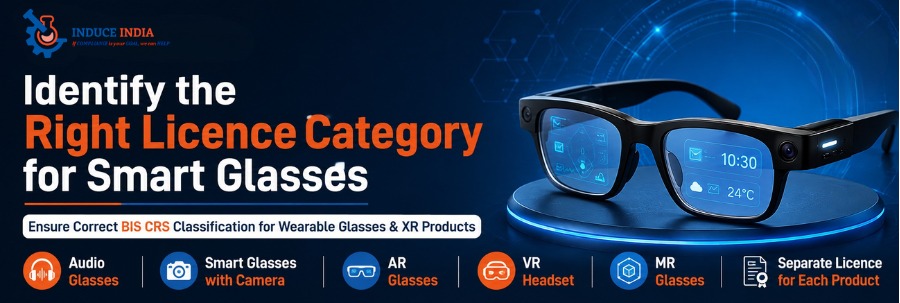
Smart glasses are rapidly moving beyond the concept of ordinary eyewear. Depending on the model, a pair of wearable glasses may function as an audio device, camera, video recorder, augmented reality (AR) device, mixed reality (MR) product, or a combination of several technologies.
For manufacturers and importers planning to sell such products in India, this creates an important BIS compliance question:
Under which BIS CRS category should the product be registered?
Recent BIS guidance dated 13 August 2026 provides greater clarity on the classification of Wearable Glasses and Extended Reality (XR) products under the Compulsory Registration Scheme (CRS).
The key point is simple:
Two products that look almost identical may require different BIS
classifications depending on their actual functionality.
Understanding BIS Classification of Wearable Glasses
A common mistake is to treat every product marketed as “smart glasses” as one single category. However, BIS classification depends significantly on what the device is designed to do. A manufacturer should therefore evaluate the complete functionality of the product before selecting the applicable CRS category and product name.1. Audio Glasses
Some wearable glasses primarily work as wireless audio devices. For example, a pair of glasses may include:- Wireless connectivity
- Built-in microphone
- Speakers
- Audio calling functionality
- Music playback
- Voice-based functions
- AI-enabled voice assistant features
Wireless Earphones and Headphones → Audio Glasses
Therefore, a product that looks like smart eyewear may actually need to be assessed as an audio product for BIS CRS purposes.2. Smart Glasses with Camera Functionality
Camera-enabled glasses require a closer examination. The classification can depend on what the camera is capable of capturing.Smart Glasses Capable of Capturing Photographs
If the device is designed to capture photographs but does not provide video recording functionality, it may fall under: Digital Camera → Smart GlassesSmart Glasses Capable of Capturing Photographs and Videos
If the glasses can capture both still photographs and video footage, they may instead fall under: Video Camera → Smart Glasses This distinction is particularly important for manufacturers because the external appearance of the two products may be virtually identical. The difference lies in the functionality of the device.3. AR Glasses and Extended Reality Products
The classification becomes different when wearable glasses provide an interactive digital display through the lenses. Where the glasses provide an overlay display visible through the lenses, they may fall within the Extended Reality Products category as: Extended Reality Products → AR Glasses BIS has also specified product names within the Wearable Glasses and Extended Reality Products framework, including:- AR Glasses
- Other AR Devices
- VR Headset
- MR Glasses
- Other MR Devices
AR, VR and MR: Why the Difference Matters
Although AR, VR and MR products are often grouped together under the broader XR terminology, their functionality is not necessarily the same.Augmented Reality (AR)
AR products generally add or overlay digital information onto the user’s view of the physical environment. For example, digital notifications, graphics, navigation information or other virtual elements may appear through the glasses while the user can still see the surrounding environment.Virtual Reality (VR)
VR products are designed to provide an immersive virtual environment, typically using a headset or similar device that presents digitally generated visual content to the user.Mixed Reality (MR)
MR products combine physical and digital environments in a way that allows virtual elements to interact more dynamically with the user’s surroundings. For BIS CRS purposes, identifying whether the product is an AR Glasses, MR Glasses, VR Headset, or another specified XR product can therefore be an important part of the certification process.A Critical Point for Manufacturers: Separate Licence Requirements
One of the most important aspects of the recent clarification is that separate BIS licences are to be granted for each specified product name under the relevant Wearable Glasses and Extended Reality Products categories. This means manufacturers should not assume that one generic “smart glasses” classification will automatically cover every variant or functionality. Before applying for BIS CRS registration, the product should be mapped against the applicable product category and specified product name.How Should Manufacturers Determine the Correct CRS Category?
A practical product assessment can start with the following questions.Step 1: Identify the Core Functions
Prepare a complete list of the product’s major functions. Does the device provide:- Audio playback?
- Calling?
- Microphone functionality?
- Camera functionality?
- Video recording?
- Digital display?
- AR features?
- VR functionality?
- MR functionality?
- AI voice assistant?
Step 2: Examine the Camera
If a camera is installed, determine exactly what it can do. Ask Does it capture photographs only? Or: Can it capture both photographs and videos? This distinction can influence whether the product is assessed as a Digital Camera or Video Camera.Step 3: Check the Display
For display-enabled glasses, determine whether digital content is displayed as an overlay through the lenses. This can be relevant when assessing whether the product falls under the AR Glasses classification.Step 4: Identify the XR Technology
If the product is an XR device, establish whether its functionality corresponds to:- AR
- VR
- MR
- Other AR devices
- Other MR devices
Step 5: Select the Correct Product Name
Once the functionality has been established, the manufacturer should identify the corresponding BIS CRS product category and specified product name. This step should be completed before submitting the application, rather than after testing or application submission.Why Correct Classification Is So Important
BIS compliance is not only about completing product testing. Correct product classification is equally important. If a manufacturer applies under an inappropriate category or product name, it can create avoidable compliance complications, including:- Application rework
- Additional documentation requirements
- Testing-related issues
- Delays in the registration process
- Questions regarding the scope of the BIS licence
- Additional certification requirements for other product variants