What is a Watt-Hour meter and why is it important?
When you get an electricity bill, the number on it is from a device called a watt-hour meter. This meter measures energy used over a period of time. It is mounted in residential, office, industrial and commercial premises for the accurate monitoring of electricity consumption.
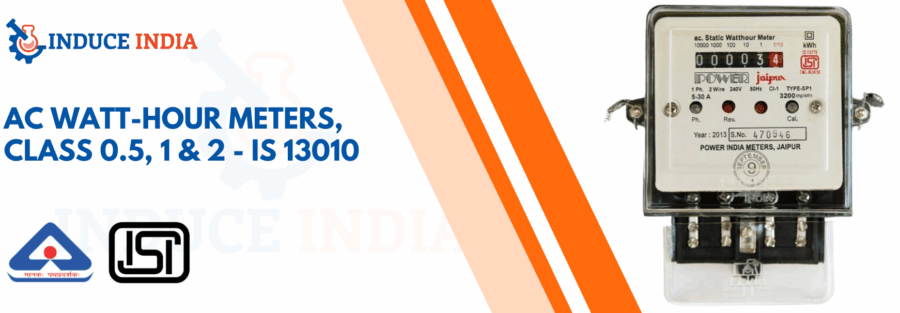
However, all watt-hour meters are not created equal. Some are used in high-precision industrial applications where a slight measurement error can cost a lot of money. Others are employed in standard homes with a small margin of error. To provide uniformity and standardisation to this, India has a national standard (IS 13010) for the design, test and classification of AC watt-hour meters.
What Is IS 13010?
IS 13010 is one of the standards issued by the Bureau of Indian Standards (BIS). It covers the requirements for alternating current (AC) watt-hour meters used for measuring electrical energy. This is a standard which guarantees the accuracy, safety and performance of every meter sold & used in India.
The standard is for static meters, the newer model with electronic components as opposed to the older rotating disc meter. It includes the accuracy with which it needs to measure the energy, how it should act when its temperature changes, how it should act when the voltage changes, and how it should act when the environment changes. IS 13010, in short, is a rulebook which regulates the way the electricity meters perform throughout the country.
Students should be able to explain the meaning of Accuracy Classes:0.5, 1, 2
The key component of IS 13010 is the concept of accuracy classes. The accuracy class of a meter indicates the permissible error of the meter’s measurement. This standard is applicable to three main classes, namely Class 0.5, Class 1 and Class 2.
The numbers in the class names are directly proportional to the maximum percentage error. So a Class 0.5 meter can have up to 0.5% error, a Class 1 meter can have 1% error, and a Class 2 meter, it can allow up to 2% error. The lower the class number, the higher the precision of the meter.
Class 0.5 – High Precision for Critical Use
The most accurate of the three is the class 0.5 meters. They are applied where accurate measurement is of the utmost significance – for example, in large industrial plants, energy generating plants, energy auditing and high-dollar commercial connections. These are also typically used as reference meters to test and calibrate other meters.
Class 0.5 is built using higher-quality components and tested with greater rigour for its high accuracy. They are not generally used in ordinary dwellings, but are always used where large quantities of energy are being measured and billed, or where a 1% error might represent a substantial loss on the part of the supplier or consumer.
Class 1- Accurately strikes a balance between accuracy and cost
Class 1 meters are a good choice for measurement accuracy and cost. They are used in medium to small size commercials, small industries and institutional type buildings like hospitals, schools and hotels and have a maximum error of 1%.
These meters are sufficiently accurate to be used for most commercial applications and are less costly than Class 0.5 meters. IS 13010 stipulates that all Class 1 meters undergo a series of tests to ensure they are performing correctly, including accuracy testing at varying load levels, thermal tests and magnetic field tests to ensure that they are not affected by external magnetic disturbances. They continue to be a trusted and popular option in numerous industries.
Class 2 – Standard Accuracy for Everyday Use
The most popular meters in a household are Class 2 meters. They are designed for the needs of regular domestic users, and have an acceptable error limit of 2%. Class 2 meters are used by most domestic power supplies in India.
2% might seem a higher error margin, but as long as it is within acceptable bounds for domestic use, where energy use is relatively small. IS 13010 also provides for testing Class 2 meters to ensure consistent performance under normal operating conditions. These meters are affordable, readily serviceable and designed to endure in the real world.
What does IS 13010 Tests and Checks?
In addition to accuracy classes, IS 13010 specifies that there are detailed tests that every meter must meet before it is usable or saleable. The tests measure the meter’s response to different levels of voltage, both high and low. They also verify the performance of the meter under extreme temperature conditions, with strong magnetic fields and voltage imbalance.
The standard also includes an aspect of starting current – the minimum current at which the meter must record the energy. This will mean that the meter won’t overlook low levels of consumption. All these stipulations ensure that a certified meter is dependable, tamper proof and consistent during its service life.
The importance of Compliance Under ISBN 13010: Compliance Matters for Everyone
IS 13010 compliance impacts every utility company, energy auditor, meter installer and even the person paying their electricity bill. If the meter is standard, you can be sure that the energy measured is both accurate and fair.
Induce India is dedicated to provide and promote electrical measurement products which are fully conforming to IS 13010. Accurate energy measurement is not only a technical necessity, it’s a matter of confidence between the provider and the consumer. Connect with us today for IS 13010-compliant AC watt-hour meters and expert guidance.