
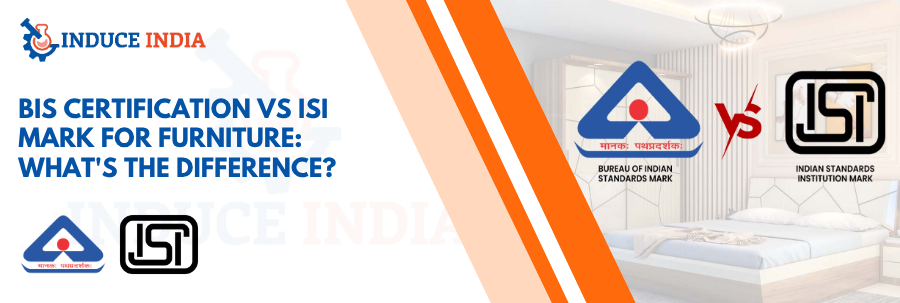
As a furniture manufacturer in India, if you have been seeing both BIS certification and ISI Mark, and you think they are the same, you might be thinking right! But if you believe that they are distinct, you may be wrong. This can be confusing, particularly when you’re trying to determine what your products actually need and what the actual difference between the two is.
Once the truth is explained straightforwardly, it’s easy to understand, and that will help you make sound decisions about your compliance course. We solve the complexity problem, just like you are doing at Induce India, for manufacturers of various industries. This blog answers the question of BIS certification versus ISI mark once and for all – and in the furniture industry.
What is BIS – The Starting point for Both
It is necessary to get the concept of BIS first before comparing it to the other one. The Bureau of Indian Standards (BIS) is the national organisation founded by the Government of India, which is responsible for developing and enforcing quality standards for products in India, irrespective of their category. The ISI Mark and BIS Standard Mark are both issued by BIS. The reason for their frequent confusion with one another is that both are issued by the same organisation.
Imagine BIS to be the umbrella organisation. The ISI Mark and the BIS Standard Mark are two terms that have the same background and context behind them, and are two different aspects of the same certification that BIS provides.
What is the ISI Mark?
One of the most famous quality marks in India is ISI, which used to be called the Indian Standards Institution, prior to the change of name to the current BIS. It has been in existence since 1955, and is used for products which are certified by BIS under BIS’s Product Certification Scheme.
So, when a manufacturer finally gets ISI Mark certification, it means the product has been tested against the respective Indian Standard ISI Mark, the manufacturing plant has been inspected by ISI Mark, and a license has been issued to the manufacturer to mark its product as ISI Mark. The mark guarantees that consumers the product’s quality and safety standards are independently met.
ISI Mark certification is applicable in the case of furniture; a few categories of furniture, which are covered by published Indian Standards, such as wooden domestic furniture (IS 2191) or office furniture (IS 7761), are applicable. The manufacturer can be fully empowered to use the ISI Mark on the certified products if he/she is certified under any of these furniture standards and have been issued with his license by the BIS.
Why is there a BIS Standard Mark, and is it different?
This is where the difference comes into play. As time went on, BIS expanded its communications of this certification to include more general terms, and the term BIS Standard Mark or simply BIS Certification became the newer term describing the same Product Certification Scheme. Nowadays, BIS certification is the term that is widely used in most government documents, tender specifications and industry communications.
For furniture manufacturers, the ISI Mark and the BIS certification are essentially the same scheme. The ISI Mark is the circular mark with the ISI inside the mark, which will be present on the furniture product. Those who request BIS-certified furniture are looking for furniture products that are manufactured based on a valid licence from BIS.
In simple words, BIS Certification is a process. Your product is awarded the ISI Mark after you’ve gone through that process. They are not two distinct systems; they are two aspects of one system.
The distinction is important to furniture manufacturers for the following reasons:
It’s important practically for several reasons. If a government tender or large institutional buyer requires furniture to be BIS certified or come with an ISI Mark, then they are looking for the same furniture that has been BIS certified and has a valid licence for the relevant Indian Standard.
Your products will not be able to be supplied to these buyers without this certification, even if you have an excellent quality product. The mark is not only a symbol, but it is also an independent endorsement of the product, based on testing and the factory’s inspection.
In some furniture classifications and use situations, it is also a legal requirement for furniture to be BIS certified. Not having the mark on these types of products can lead to fines, product seizure and damage to the reputation that is hard to quickly recover from.
The furniture sector is subject to both mandatory and voluntary BIS certification
The compulsory and the voluntary systems are in use for BIS Certification in the furniture sector, depending on the category of the furniture and its use. BIS certification is becoming a requirement for furniture in institutional, public or government establishments as a result of government notifications and procurement policies. In other furniture categories, certification is still not mandatory, but it is a huge competitive and credibility edge over other non-certified furniture that can be found in the market. With constantly changing regulations, always check with a qualified compliance specialist what is required for your product category.
Induce India offers furniture manufacturers a variety of benefits, such as:
The BIS certification process comprises identification of the appropriate Indian Standard, detailed documentation, product testing at BIS-recognised laboratories, factory inspection and formal application for the licence with BIS. Without the proper support, this process might seem complicated, time-consuming and overwhelming for manufacturers with active production going on at the same time.
We manage the whole BIS furniture certification process for furniture manufacturers from start to finish, with the expertise of any external laboratory. We deal with the entire BIS furniture process from start to finish with any external laboratory’s expertise. Our team identifies Indian Standards suitable for your product range and reviews your manufacturing and quality control processes, prepares complete documentation, coordinates laboratory tests, helps with factory inspections and conducts all formal communication with BIS on your behalf efficiently and cost-effectively.
Conclusion
BIS certification and the ISI Mark are not two different systems; they are a process and the result of the same certification system. This clarity for furniture manufacturers in India eliminates misconceptions and establishes a clear understanding of the meaning of compliance for your business.