We are usually careless about safety when it comes to electricity in our homes. We turn on a light switch, and the light goes on. A complicated system is, however, operating behind our walls to ensure that we are safe from fire and electric shocks. In India, there are certain rules developed by the Bureau of Indian Standards (BIS) to ensure that these safety devices indeed perform.
This standard deals with Residual Current Breakers with Overcurrent Protection (often referred to as RCBOs). At Induce India, we assist manufacturers and businesses to learn these technical requirements to be able to make safe and certified products available in the Indian market. This blog will describe the meaning of an RCBO and the difference between it and other devices, and why this standard is a necessity in terms of electrical safety.
What is an RCBO? The “Two-in-One” Protector
In order to get familiar with an RCBO, you must be familiar with two of its cousins, the MCB and the RCCB. A Miniature Circuit Breaker (MCB) will guard your wires from overheating or from shorting. A Residual Current Circuit Breaker (RCCB) helps to avoid electric shocks to humans.
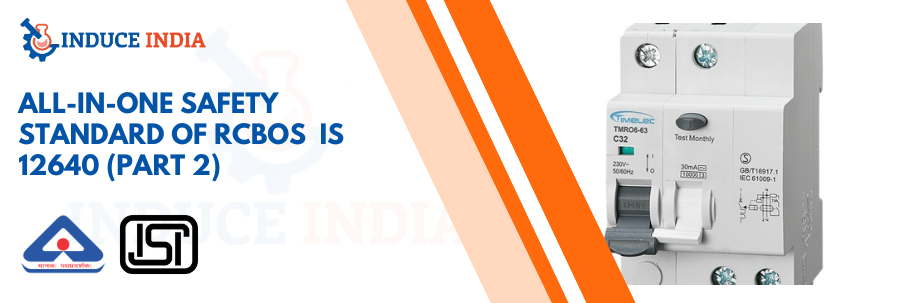
RCBO is a single device that can perform both tasks. It is as though you have a bodyguard and a fire warden combined. It will save you the trouble of getting a shock (because of leaking electricity), and it will save your house (because of overloaded circuits) from fire. It uses less space in your electrical board as it is a combination of two functions, and offers the ultimate protection possible.
Breaking Down IS 12640 (Part 2)
The official rulebook of the RCBOs in households and similar places is the Indian Standard IS 12640 (Part 2). The standard is very similar to the international standard IEC 61009-1.
This standard aims to put in place a standard such that, in case an RCBO is installed in your home, it is sensitive enough to save a life and robust enough to withstand the day-to-day electrical needs of a modern family. It dictates the quality, durability and performance which all the manufacturers of the products have to reach to be able to sell their products in India legally.
The Standard Requires Important Safety Features
To pass the tests in IS 12640 (Part 2), an RCBO must demonstrate that it is capable of dealing with various hazardous conditions:
Earth Leakage Protection: This should be able to detect whether the circuit is leaking (e.g., via the body of a person). To be used in the home, it should have a tripping point of 30mA, which is the maximum of human safety.
Overload Protection: When you use too many heavy appliances in one socket, the wires would be hot and cause a fire. This “overcurrent” should be detected by the RCBO and cut power.
Short-Circuit Protection: When two wires come in contact with each other, a huge explosion of energy takes place. The RCBO should have the capability to interrupt this huge current safely without exploding or failing.
Reliability: The criterion is that the device must be flawless in various temperature and humidity conditions, which is highly demanded in India with its changing climate.
The reason as to why BIS Certification and ISI Mark are required
Electrical safety is a priority for the government in India. Due to this reason, RCBOs are registered under the Compulsory Registration Scheme (CRS). This implies that any production, importation or sale of an RCBO in India must not be done without a valid BIS certification and ISI Mark.
At Induce India, we experience the way in which this safeguards consumers. The certification method has strict laboratory tests; the device is tripped thousands of times to make sure that the springs and mechanical components are not worn out. Once you find the ISI mark on an RCBO, you are aware that it has gone through the hardest tests imaginable.
The Advantages of RCBOs vs Conventional Systems
In houses that were older, a single, large RCCB was likely to be used to protect the entire house. The issue was that even when there was a minor leakage of a small amount of iron, the electricity of the whole house would be cut off. This is termed as nuisance tripping.
When individual RCBOs are used in the various rooms (as suggested by modern standards), only the room with the fault is de-energised. All your other lights and appliances remain on. This will make it a lot easier to locate the problem and ensure that your home is running smoothly. In addition, an RCBO will occupy less space than an MCB and RCCB together, thus keeping your electricity panel tidy and small.
What Manufacturers Should Know?
Compliance with IS 12640 (Part 2) is a process, as long as you are a manufacturer or importer. It begins with determining a certain Type of RCBO (e.g., Type AC or Type A) depending on the type of current that it is capable of operating.
The testing procedure requires the checking of the “Breaking Capacity of the device- the amount of current it can safely interrupt when there is a short circuit. It also contains Dielectric Tests to ensure that the insulation is robust. Any failure in any of these tests will imply that the product cannot be sold. That is why it is important to consult the experts so that your design could be able to meet the requirements of the Indians in the first place.
How to test Quality at Home?
To be safe, you do not have to be an engineer as a homeowner. Checking your RCBOs: You can look at a few simple things to check your RCBOs:
Look at the ISI Mark: It is a symbol that you must not purchase a circuit breaker without.
Find the “T” Button: All RCBOs have a test button. Pressing this once a month should be done. In case of a power trip, the device is operational. In the event that it does not trip, then you should contact an electrician.
Read the Label: It must contain the IS 12640 (Part 2) and sensitivity of 30mA with regard to general home protection.
The way India contributes to the Industry
The path to becoming a BIS-certified can be perplexing. It involves numerous papers to fill in, samples to be sent to certified laboratories and a very strict schedule to adhere to. Induce India takes the form of your professional guide with this.
We assist the manufacturers in establishing their documentation, lab testing schedules and contacting the Bureau of Indian Standards. We are certified and can guarantee you quick and accurate certification that can mean your safety products are in the hands of the Indian consumers, without unneeded delays.
Conclusion: Investing in Peace of Mind
Electricity is a powerful tool, but it must be respected. The IS 12640 (Part 2) standard is not just a piece of paper; it is a shield that protects millions of Indian families from electrical accidents. By ensuring that RCBOs meet these high standards, we can significantly reduce the number of electrical fires and shocks in our country.
Whether you are building a new home or manufacturing electrical gear, prioritising these standards is the best investment you can make. At Induce India, we remain committed to supporting a safer, more compliant India by helping the industry reach the highest levels of quality and safety. Stay safe, stay certified, and always choose quality when it comes to electricity