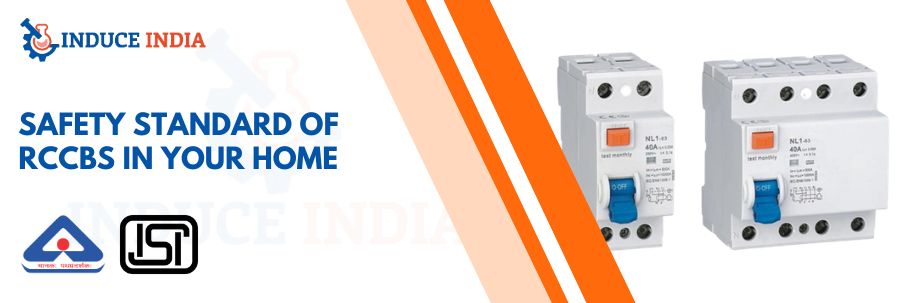
Our modern world runs on electricity, and nowadays, everything, our kitchen, our home office, etc., is electrically powered. But, at the same time, with such convenience comes some necessity for safety. The Bureau of Indian Standards (BIS) in India has stringent regulations to make sure that the electrical devices we employ do not endanger our lives.
This standard includes Residual Current Operated Circuit Breakers (RCCBs) that do not have overcurrent protection. We are experts in assisting businesses to traverse such complicated regulations at Induce India.
What is RCCB, and why does it matter?
An RCCB is a safety gadget that helps to shield humans against electric shocks. You can consider it a digital watchman of your electrical system at home. It is connected to continuously check the current that flows out on the live wire and back on the neutral wire.
When everything is correct, the outgoing current and the incoming current should match. In case of a difference, it implies that there is a leakage of electricity somewhere. This leakage may be flowing via a faulty appliance, or in the worst-case scenario, it may flow via a human body. This slight difference is detected by the RCCB, which, in less than a second, clears the power, possibly saving a life.
Breaking Down IS 12640 (Part 1)
The Indian Standard IS 12640 (Part 1) is specifically for RCCBs that do not have built-in overcurrent protection. This implies that these devices are simply concerned about the detection of earth leakage and avoiding electric shock.
This standard complies with international safety standards (IEC 61008-1), and thus the products produced and marketed in India have international standards of quality. It includes units applicable in residential and other places where the users of electricity are not necessarily electrical professionals.
The Standard has some important Technical Requirements
To be certified to IS 12640 (Part 1), an RCCB has to endure a number of intense tests. These specifications make the device very reliable over the course of years.
Sensitivity Levels: The standard establishes the sensitivity that the device should have. The most typical sensitivity is 30mA (milliamperes) in the protection of human life. This is because a current higher than this can cause a person’s heart to stop.
- Operating Time: An RCCB should be able to trip nearly immediately – typically within 30 to 40 milliseconds.
- Temperature Resistance: India has various climates, and these devices should be able to perform ideally in the extreme temperatures of hot and cold without mechanical components becoming stuck.
- Dielectric Properties: This makes the insulation of the device sufficiently powerful to ward off internal electricity leaping away across the divides.
Compulsory Registration Scheme (CRS)
In India, the RCCBs are required to have the ISI Mark as it is mandatory by the government. Pursuant to the Quality Control Orders (QCOs), you may not legally market or make such circuit breakers absent the BIS certification.
This is where the Induce India comes in. We assist manufacturers in knowing the testing procedures needed in IS 12640. There is no laboratory testing, documentation and final certification, where we are satisfied that the products that reach the market are safe to the end-user. To a consumer, the presence of such an ISI mark is an assurance that the product has gone through all the safety hurdles.
Difference Between RCCB and MCB
Several house owners become bewildered between an RCCB and an MCB (Miniature Circuit Breaker). One should also be aware that they are used to two very different purposes.
Your appliances and wires are safeguarded by an MCB. It will trip in case it short-circuits or when you overload a socket with too many heavy machines. Nevertheless, a person may not be tripped by a live wire of an MCB.
Conversely, RCCB (according to IS 12640) is meant to safeguard human beings. It is able to sense the minute leakage of current that happens when an electric shock is encountered. To have a really safe home, you must have both an MCB to the equipment and an RCCB to the people.
The importance of Compliance to Manufacturers
As a manufacturer or an importer, not only is it a matter of law, but also of brand reputation to comply with IS 12640 (Part 1).
Disaster may be caused by electrical fires and accidents that result in huge legal liabilities and loss of trust. Adhering to the BIS standards, you are able to show your company that human life is valued. Moreover, your goods may be confiscated, and your company may be subjected to severe fines in case of the lack of this certification. The process of testing includes examining mechanical endurance, resistance to rusting and the functioning of the device with tripping thousands of times without failures.
How to Check the Quality at Home
You, as a consumer, can also contribute to your safety. When purchasing a circuit breaker for your home, always look for the following:
- The ISI Mark: It is the most significant quality indicator.
- Sensitivity Rating: Make sure that it is 30mA when used at home.
- The Standard Number: It should explicitly mention IS 12640 (Part 1).
- Test Button: Each RCCB has a small “T” or “Test” button. This should be pressed once a month so that you are sure that the internal mechanism is still in operation.
The way Induce India helps the Industry
Many companies may find it hard to negotiate the world of BIS and IS 12640. In the case of Induce India, we are the interface between the manufacturer and the regulating bodies.
Our end-to-end consultation covers the identification of the correct laboratories to be used in testing, the preparation of the technical files and handling of the application process with BIS. We aim at ensuring that the certification process is hassle-free, to ensure that manufacturers concentrate on producing good quality safety gear for Indian homes.
Summary: Safety is not an Option.
A safe home is based on electrical safety. The IS 12640 (Part 1) standard makes sure that the RCCBs that we use are not merely plastic boxes, but very precise life-saving tools.
You may be a homeowner and need to renovate your home, or you may be a manufacturer and need to enter the Indian market; knowing these standards is the initial step to excellence. At Induce India, we feel proud to contribute towards the mission of a safer India by ensuring that all electrical products are of the best quality standards.