A Quick and Easy Device for a Very Important Task!
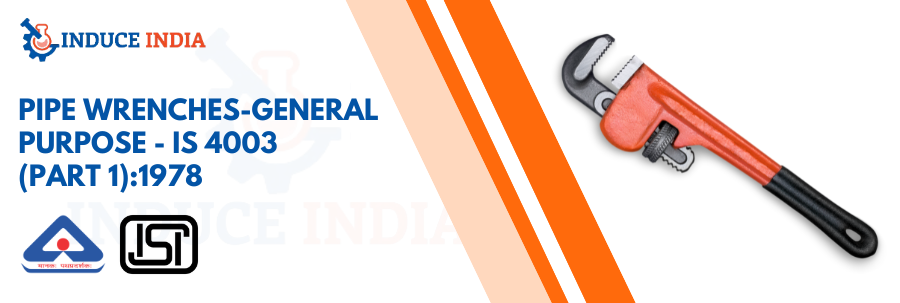
Open any Indian plumbing shop, industrial plant or maintenance shop, and you will be able to spot almost certainly a pipe wrench on the workbench. It’s one of those tools that you know when you see it, but you don’t always consider. A pipe wrench is a hand tool that is designed to grip and rotate pipes, tubes and rounded surfaces which a standard spanner cannot.
A pipe wrench might appear simple, but it needs to withstand a considerable amount of force. The force applied by a plumber or technician to access a pipe that is “tight” should result in the wrench having a firm grip and not slipping or breaking under pressure. A poorly manufactured pipe wrench will not only fail to do its job, but it is also hazardous for the user.
Hence, the Bureau of Indian Standards (BIS) has created Indian Standard IS 4003 (Part 1):1978 for general-purpose pipe wrenches. We provide manufacturers, importers and businesses with an understanding and compliance with this standard at Induce India. This blog gives an explanation of what it entails and why it is essential for all who deal in the manufacture or sale of pipe wrenches in India.
The pipe wrench, as well as the bolt cutter, is a specialised type of hand tool
A pipe wrench is an adjustable hand tool with one stationary and one moving jaw that has serrations on them. The jaws are set at an angle which creates a tighter grip as they are turned. A self-tightening feature makes the pipe wrench extremely useful on round or cylindrical objects such as metal pipe and tube fittings.
The most common one is the straight pipe wrench, which has its jaws pointing in the same direction. It is adjusted by rotating a knurled nut, which forces the upper jaw over various pipe sizes. Plumbers, pipefitters, maintenance workers, and throughout the industry, general-purpose pipe wrenches are used in myriad applications daily.
What Is IS 4003 (Part 1):1978?
IS4003 (Part 1):1978 is an Indian Standard by BIS for general-purpose pipe wrenches. It specifies the material, size, surface and mechanical characteristics, as well as testing criteria of a pipe wrench acceptable in India. Part 1 focuses on general-purpose pipe wrenches, which are most commonly used tools throughout the country; they are strong, reliable and of uniform quality among all manufacturers.
Key Requirements Under IS 4003 (Part 1):1978
The body of the pipe wrench, that is, the handle, fixed jaw and movable jaw should be of suitable grades of steel capable of the required strength and durability, according to the standard. Inadequate material can actually endanger a person’s safety, and with this standard, minimum material specifications are given.
IS 4003 (Part 1):1978 specifies normal sizes depending on the overall length of the wrench, which varies from about 200 mm to 900 mm. The standard also provides for the opening capacity of the jaws for each size, that is, the maximum pipe diameter that each wrench will accommodate. All tools use the same dimensions and will therefore be compatible with each other on site.
One of the most important parts of a pipe wrench is the gripping teeth on the jaws. The standard defines the shape, depth and spacing of serrations to provide a secure, non-slip grip to the user during use. If the teeth are too shallow or poorly formed, the wrench will slip when pressure is applied, which is potentially dangerous when performing heavy-duty tasks.
Finish & Surface Quality: All pipe wrenches should be crack-free, free from sharp edges, rough surfaces and other surface irregularities which may lead to safety or comfort issues. The proper finish also enhances the corrosion resistance and results in a considerable extension of the working life of the tool.
Adjustment Mechanism: The slide and move of the movable jaw should be smooth with no play or wobbling. The adjusting nut should be free to rotate, but should securely lock when adjusted. The standard sets out requirements for the function and quality of this mechanism to make sure it is reliable and performs well in the field.
Each size of pipe wrench should be capable of being tested for strength and load to ensure that it will not become damaged, cracked or permanently bent when tested under a specified torque. This test directly proves the wrench’s strength for the rigours of use in the field.
Marking Requirements: All compliant pipe wrenches must be marked clearly with the manufacturer’s name/trade mark and the size of the wrench with 100% traceability and accountability.
Why IS 4003 (Part 1):1978 Matters?
For Manufacturers, BIS certification means the production of goods that meet a nationally recognised quality standard, it helps to increase buyers’ trust, and it gives access to government procurement opportunities. As an importer, it is important to ensure pipe wrenches conform to the standard before they arrive in India; otherwise, they will be rejected or penalised. When you’re the buyer or end user, the BIS Standard Mark provides a guarantee of safety and longevity on the job.
How can India help?
“Induce India” makes the pipe wrench BIS compliance process easy for manufacturers and importers in India. We are committed to helping you understand exactly what IS 4003 (Part 1):1978 requires, preparing all technical documents, arranging testing in BIS-approved laboratories, and guiding you through the entire certification process to save time and money.
Conclusion
A pipe wrench can be a simple tool, but IS 4003 (Part 1):1978 promises it to be a safe and reliable one. Manufacturers, importers and buyers of hand tools must adhere to this standard to ensure quality assurance in the hand tools industry. Give Induce India a call today and get expert guidance on IS 4003 (Part 1):1978 and all your BIS certification requirements.