
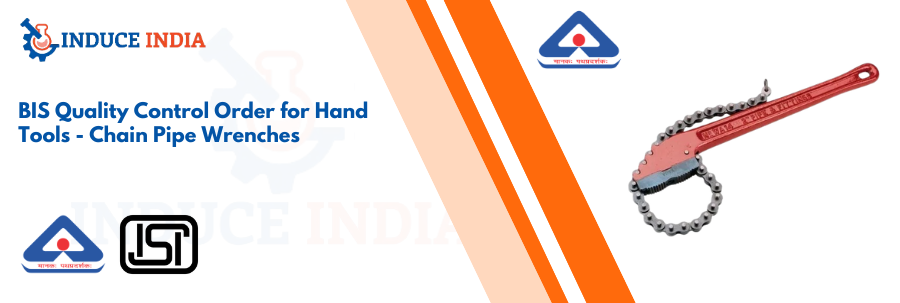
In the current scenario, the Indian manufacturing landscape is rapidly evolving. Staying compliant has become crucial for business survival. If you are a business, making or selling Chain Pipe Wrenches and want BIS Certification for Manufacturers, there is an update for you. The update is about the BIS Quality Control Order for Hand Tools, marking an important shift in the process of how these high-torque instruments are produced and traded.
Recently, the Department for Promotion of Industry and Internal Trade (DPIIT) revised the Hand Tools (Quality Control) Order, 2025. According to this order, some tools must be satisfactory to comply with the strict safety standards established by the Bureau of Indian Standards to sell them in Indian Markets.
The Evolution of the Hand Tools Quality Control Order
It was started in the year 2024 and was under the name of the Hand Tools Quality Control Order. The government then improved these rules by making another fresh order in 2025. The Department for Promotion of Industry and Internal Trade(DPIIT) performs this update that offers a clear guideline to the standardisation of the necessary workshop tools.
The compliance phase was less strict in the past, though now, in the 2025 order, the ISI Mark is mandatory. In the case of Chain Pipe Wrenches, these are the technical specifications that are contained in IS 4123:1982.
Understand the Change
The heavy-duty tools are the chain pipe wrenches, which are used to turn large-diameter pipes and those with high leverages. They are primarily applied in the oil rigs, industrial refineries and high-pressure plumbing, hence a small failure of the chain of this tool can precipitate huge accidents at the workplace.
The standard provides a guarantee to the fact that the tools are constructed to withstand extreme stress. The standard covers:
- Material Integrity: the steel quality that is utilised in making the chain links and handles.
- Hardness Levels: Special Vickers hardness is needed on the teeth of the jaw in order to avoid slipping.
- Design and Dimension: Standardisation of the sizes of 50mm to 300mm nominal pipe capacity.
- Breaking Lord: There are strict specifications on the maximum tension chain that will be allowed to operate before breaking.
Important Deadlines To Be Met
The Ministry of Commerce and Industry has concentrated on a phased implementation strategy so as to ensure that small businesses can have sufficient time to upgrade their manufacturing process and quality control laboratories. These are the implementation dates that are based on enterprises such as small enterprises: 1 January 2027, micro enterprises: 1 April 2027, and large and medium enterprises: 1 October 2026.
The BIS Certification Process has many important elements
The manufacturers have to adhere to an organised process in a bid to initiate a successful transition to a BIS-compliant facility. It is an essential and critical transformation in quality management and not just a mere paperwork.
-
In-House Laboratory Setup:
The BIS Regulations (under Scheme I) require that manufacturers have an in-house laboratory. When it comes to machines that test hardness, tensile testing machines, as well as precision measuring scales, the lab must have the machines available in case of chain pipe wrenches.
-
Design of inspection and audit: Factory Inspection and Audit:
BIS will then undertake a physical inspection of the manufacturing unit after the application is successfully made. The concerned official tends to seek a common production process and ensure the Quality Control Personnel are qualified to carry out the necessary tests.
-
Sample Testing in NABL Labs:
Samples are collected by the BIS official for the purpose of further testing in the BIS-authorised laboratory. The tools must pass all the parameters in order to get the license.
-
The Standard Mark (ISI):
Once Certified, the manufacturer is given a unique Certification Management/License (CM/L) number. This number must be embossed onto every tool along with the ISI mark, reflecting a sense of visual guarantee to the end user.
-
Exemption for the Exports:
It is important to note that the Quality Control Order applies only to products that are sold within the Indian Markets. If a manufacturer is producing the chain pipe wrenches specifically for exports, then they are exempt from this order and must maintain the required clear documentation of the intent to export.
Why Compliance is Your Competitive Advantage?
The procedure of getting BIS certification requires investment; it also serves as a powerful market inducer for your brand. The certification ensures a sense of trust and reliability as the certification crucial prerequisite in order to have large-scale private contracts or government tenders. Legal security is also provided under the BIS Act of 2016, as the sale of non-compliant tools may lead to heavy fines, imprisonment or other consequences. Aligning well with the IS 4123 standards, Indian manufacturers align themselves closer to the international quality benchmarks, making it easier to further penetrate global markets eventually.
Avoiding the Common Pitfalls
Many manufacturers experience delays in the process of applying for certification, leading to bottlenecks at the testing stage in laboratories, while the deadline is near. To ensure a smooth transition, businesses should apply timely and not wait for the deadline to arrive, as even a small skip or mistake can cause big issues.
Conclusion
The BIS quality control order for hand tools is a transformative order for the industry. Specifically for the Chain Pipe Wrenches Segment, it highlights a shift from price-first to safety-first. By emphasising the quality of your Chain Pipe Wrenches, you are not only abiding by the rule, but you are also building and developing a safer, professional and profitable brand. Don’t wait for the last moment, start checking your production processes today so that when the deadlines arrive, your business is ready to flourish and lead the markets