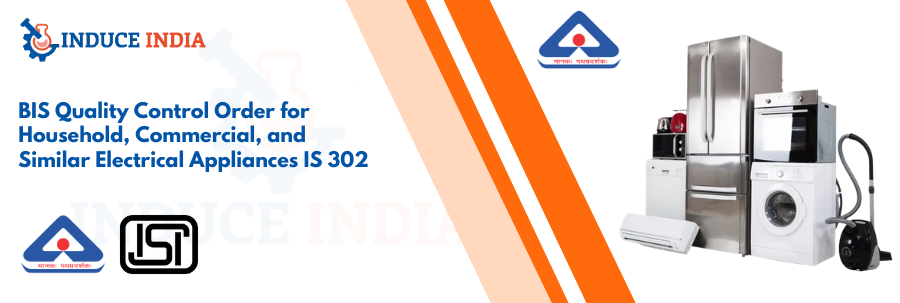
The Indian market is full of variations and is ever evolving in nature because of its fast and diverse population. In a country with such a huge population, safety isn’t just about luxury but it’s a legal mandate. The Indian government has recently laid its emphasis on consumer safety by introducing the Safety of Household, Commercial and Similar Electrical Appliances (Quality Control) Order, 2025.
The order works around the IS 302 (Part 1) standard, and talks about the changes in how electrical goods are manufactured, imported, and sold in India. Understanding this BIS Quality Control Order by the businesses and consumers is crucial to ensure that the appliances and gadgets which we use every day and are part of our lives on a daily basis are safe, reliable and legally compliant.
What is the BIS Quality Control Order for Electrical Appliances?
The Quality Control Order (QCO) is an order directive issued by the Department for Promotion of Industry and Internal Trade (DPIIT). This order says that all the electrical appliances and gadgets for the usage in households, commercials or other similar usages, must ensure to have the ISI Mark to be legally allowed to be sold in the Indian market for its consumers.
This order covers all the appliances that lie within a selected/decided voltage range and not exceeding 250 Volts for a single – phase and 480 Volts for the other equipment, including the DC and battery based devices.
By the implementation of IS 302 (Part 1) 2024, the government aimed to put an end to the sub-standard quality imports and also keep an eye on the locally produced products that pose the risks of electric shocks, fires or mechanical failures.
Scope of IS 302 (Part 1): The “Safety Umbrella”
The standard IS 302 (Part 1) is all about the General Requirements standard. This standard acts as the foundation stone for the safety of all electrical appliances and gadgets.
The specific concerned tools have their own place in Part 2 standards , for instance like for irons or kettles. Overall Part 1 talks about the basic safety concerns that apply to each and every product.
List of the Key Appliances that are Covered Under this Order:
The list is extensive and covers almost every modern convenience equipments like the following:
- Kitchen Gadgets like the cooking ranges, hobs, ovens, frying pans, deep fat fryers, coffee makers, food processors etc.
- Cleaning items like the vacuum cleaners, floor treatment machine and water suction cleaners.
- Personal care essentials like electrical shavers, hair clippers, and oral hygiene appliances.
- Commercial products like dishwashing machines, commercial hoods, boiling pans and other things.
- Specialty items like insect killers, massage appliances, electric call bells, and even the commonly used aquarium heaters.
Critical Timelines for Compliance:
The Ministry of Commerce and Industry has provided an implementation process based on a set of different phases while allowing the businesses to align their production procedure as per the new BIS certification requirements.
On the basis of the category of the enterprises, the implementation dates are as follows:
- Small Enterprises: 19 June, 2026
- Micro Enterprises: 19 September, 2026
- Medium and large Enterprises: 19 March, 2026
IMPORTANT: The dates provided above are as per the latest 2025 notification.
Some Essential Safety Tests Under the IS 302 (PART-1):
In order to ensure a high level of customer trust, the IS 302 standard requires tough and strict lab testing and failing in it, the product cannot carry the ISI mark.
-
Protection Against the Electric Shock:
This test is to ensure that live parts are not accessible to the user, even during accidental contact. It also includes a special test using a specialized test finger to check for any gaps in the appliance casing that could lead to a shock.
-
Earth Continuity and the Provision for Earthing:
In case of appliances that require grounding, this test is used to verify that the metal parts used are properly connected to the earth terminal. In the case of any fault in this, the electricity must have a safe path to the ground rather than to the user.
-
Leakage Current and Electric Strength:
In some cases even if a product is off, it can leak small amounts of current.This test is carried out in order to ensure that the intensity of leakage current at the operating temperature is within the safe limits and that the insulation can handle such high-voltage surges without breaking down.
-
Thermal Protection and the Overload Management:
This standard is to check if the appliance has the adequate thermal cut-offs. For instance if a motor jams or a heater stays on too long, the device must safely shut down before it becomes a fire hazard.
-
Moisture Resistance:
As many appliances and gadgets are used in kitchens or bathrooms like kettles or shavers and are part of lives on a daily basis, it becomes necessary that they are good enough to withstand the humid conditions or minor splashes without making the internal circuits become dangerous.
The Certification Process: Step-by-Step
The process of obtaining a BIS License under Scheme-I is a well structured procedure that requires technical precision as well as documentation.
The steps involved are as follows:
-
Filing an Application:
Manufacturers must apply on the prescribed BIS portal, providing the asked details of the manufacturing unit and the specific products.
-
In-House Testing Setup:
It is important for a factory to have its own testing facilities in order to perform routine checks on every unit produced in the premises.
-
Third-Party Lab Testing Facility:
The samples are collected and then sent to a BIS-recognized laboratory for a full evaluation as per IS 302: Part 1: 2024.
-
Inspection of the Factory:
A BIS authorised auditor visits the factory to verify the production process, quality control systems, and the competency of the staff and ensure basic conditions and norms are followed.
-
Grant of ISI Mark:
If the lab reports and factory audits are successful, the manufacturer is granted with Certification Management/Licence – CM/L number.
The role of Quality Control Order as a Game-Changer for Manufacturers:
The compliance initially requires investment,but it also “induces” significant long-term business advantages such as follows:
-
Entry into the Market:
It is very clearly visible that many large retail chains and e-commerce platforms are now refusing to list non-BIS compliant electrical goods in their listings.
-
Government Tenders:
Compliance is not only a crucial but also a mandatory requirement for any sort of government procurement or Make in India initiatives.
-
As a Defense Tool Against Liability:
Having an ISI mark ensures the consumers that the manufacturer took all due diligence steps in order to ensure safety while protecting the brand from any sort of legal fallout in case of accidents.
For the Purpose of Consumer Awareness: How to Spot a Genuine Product?
As a consumer, one should always look for the ISI Mark and the CM/L number (a 7 or 8-digit code) on the outer packaging of the product or on the body of the appliance.These details can verified by checking for this number on the BIS Care App to have basic knowledge of the things like the manufacturer’s license is still active and valid for that specific product.
Summary of Compliance Requirements:
We can see the following summary of the parameters and their basic requirements:
- Applicable Standard: IS 302 (Part1):2024
- Voltage Limit: Up to 250V(1-Phase), 480V(3-Phase)
- Marking: Mandatory ISI Mark+ CM/L Number
- Penalty for Non-Compliance: Fines, product seizures and imprisonment under BISAct 2016
Conclusion:
The Safety of Household, Commercial and Similar Electrical Appliances Quality Control Order,2025 is a crucial step towards a safer India. By standardizing the general requirements under IS 302(Part-1), the government is trying to ensure that the heart of every Indian home, the kitchen and the utility room is protected from the hazardous electrical happenings.It is the time to invest in quality for the manufacturers. Early compliance is better to avoid the legal penalties as well as position your brand as a leader in the new era of high standard manufacturing in INDIA.