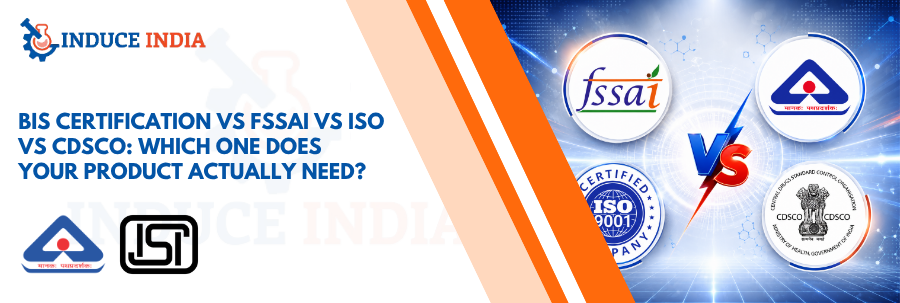
When you’re starting up a business in India, you’re sure to find tons of acronyms you will need to understand. The list of BIS, FSSAI, ISO, CDSCO, etc. keeps on growing, and most of the entrepreneurs don’t know which one is applicable to their product. The fact is, each certification has a wholly distinct aim and selecting the incorrect one can be a waste of both your time and cash. This blog explains in detail what each certification entails, so you can determine where your product fits.
Why is BIS Certification needed?
The Bureau of Indian Standards (BIS) is India’s national organisation that establishes safety and quality standards for a variety of products. In the case of electronics and IT goods, kitchen appliances and industrial goods such as cement and steel, BIS certification is most likely required for you if you manufacture or import these goods. Examples of such products are mobile chargers, laptops, LED lights, pressure cookers, etc., which are in the BIS schemes such as CRS or ISI Mark. These products cannot be sold or imported in India without this certification. To sum up, for any product that is a physical item with safety-related issues, particularly electrical or mechanical, you’re likely to want to start with BIS.
Why is it that FSSAI License For?
The Food Safety and Standards Authority of India (FSSAI) is a body that is dedicated to food and, as the name implies, Food Safety. An FSSAI license or registration is required for any business engaged in manufacturing, packaging, storing, distributing or selling food. This is true for any small bakery, packaged snacks business, restaurant or large food processor. Depending on the size of your business, you can have basic registration, a state license or a central license. In case your product is designed for the purpose of human consumption (food/beverage), FSSAI will not be left behind, and BIS/ISO will not replace FSSAI.
What is ISO Certification For?
The ISO certification is very different from BIS or FSSAI. Rather than certify a single product, ISO certifies your business processes and management systems. It is a document that’s made by the International Organisation for Standardisation (ISO), which is recognised globally by many countries and is used for manufacturers, service providers, IT companies, hospitals, logistics and even government organisations. Quality Management Systems are certified by ISO (International Standards Organisation) and apply to all sectors and services, and are much broader in scope than product-specific certifications. ISO is not compulsory like BIS, but it is generally voluntary, and if it is, it adds to the credibility of the firm, particularly with international firms and government tendering. If you are interested in showing your company has processes that are consistent and are quality-driven, ISO is the certification you are looking for.
Why CDSCO Registration?
The Central Drugs Standard Control Organisation (CDSCO) is responsible for regulating drugs, medical devices, and cosmetics in India. In case your business involves pharmaceuticals, medical equipment, diagnostic kits, or cosmetic products, it is crucial to get CDSCO registration before making, importing or marketing them. It usually entails comprehensive documentation, such as business registration documents, product details and test results, then verification and the assessment of the products. Healthcare products are extremely sensitive, and compliance with CDSCO requirements is very strict; failure to comply may result in serious legal consequences. When your product comes in direct contact with human health, be it in medical, treatment or personal care, CDSCO is a certification that your business cannot miss.
Students will compare the four at a Glance
In a nutshell, BIS deals with product safety (electronic goods and industrial goods), FSSAI is 100% about food, and ISO is about the efficiency of your business processes; CDSCO is related to product safety of health-related goods such as drugs and medical devices. The other difference, which is equally important, is scope and validity. ISI is domestic and product-based, while ISO is global and considers the overall management system and not just one item. FSSAI and CDSCO are both focused on Indian market sectors, but are directed at completely different industry sectors – food and healthcare, respectively. These differences are important to understand at the outset to avoid even applying for a certification that you are not eligible for.
Does Your Business Need More than One?
A business may require more than one of these certifications, and it is not uncommon for them to require more than one of these certifications. For example, a company producing electronic medical devices would require BIS certification for the electrical component part and CDSCO registration due to the medical devices. Likewise, a food processing business could require FSSAI certification for their product and ISO to ensure that they have a robust quality management system for those who are interested in purchasing their product from overseas. But don’t expect that one certificate applies to all; it is best to consider the product under many different aspects, its composition, its use, and its target market, and then determine which of these is best for it.
The importance of getting this right
If you opt for the incorrect certification program – or fail to enrol in any – you could end up with delayed shipments, market rejection or even problems later on. A lot of businesses only discover they were in need of a given certification when their product is caught in customs or rejected by a website. That is the reason it is cost- and time-efficient to know about them in the early stages of the production process, before expansion of production or importation.
Induce India can assist you with the following:
We, at Induce India, have made a lot of effort to understand the exact certification requirements of their products for manufacturers, importers and food businesses in Lucknow and beyond. From the outset, our team can guide you through the correct path of BIS, FSSAI, ISO or CDSCO so that you stay compliant and audit-ready all the time without taking any guesses.
No business is too small or too big; that is the reason why there is no one-size-fits-all certification in India, and that is why so many businesses feel overwhelmed at the start. With this understanding, you’ll be able to tell that BIS regulates product safety, FSSAI regulates food, ISO regulates business processes, and CDSCO regulates health products, and this means the choice becomes much less confusing. Contact Induce India for customised advice on which certification is best suited for your product.