
The most common hand tool in every toolbox
Have you ever used an open-end spanner (open-jaw wrench)? If you have tightened a bolt, fixed a dripping tap or even set up a piece of furniture, you’ve most likely used an open-end spanner (open-jaw wrench). It is one of the most common hand tools used all across the globe and can be seen in homes, workshops, factories, garages and construction sites in India each and every day.
The open-jaw wrench seems straightforward, a flat metal piece that is U-shaped to fit around a nut or bolt head. However, though the tool looks simple enough to make, it must be constructed to the precise specifications to be safe and effective in the physical forces necessary for tightening and detightening fasteners.
Hence, the Bureau of Indian Standards (BIS) came out with IS 2028:2004 – Indian Standard for Open Jaw Wrench and Spanners. Induce India assists businesses and manufacturers to understand and adhere to this standard.
What is an Open-Jaw Wrench?
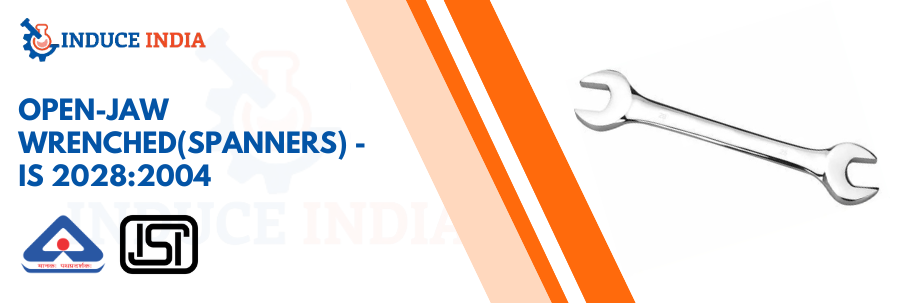
An open-jaw wrench (also called an open-end spanner) is a hand tool that has one or two secure jaws at its ends. These openings are carefully dimensioned to accommodate certain nut and bolt sizes. The jaws of a wrench hold two flat faces of a hex nut or bolt head and can be used to exert a turning force on the nut or bolt when tightening or loosening it.
Available in a variety of sizes, mostly in millimetres, open-jaw wrenches are used in almost every industry, ranging from household plumbing to auto repair, heavy engineering and industrial maintenance. They are easy to use and install, and are also very fast.
What Is IS 2028:2004?
The Indian Standard published by BIS provides the requirements for open-jaw wrenches and spanners used throughout India as per IS 2028:2004. The standard lays out a series of material, size, jaw opening tolerances, surface finish, hardness, and performance testing requirements for all open-jaw wrenches to qualify for sale and use in India.
This standard was revised in 2004 to incorporate new requirements and harmonise with international practices, and also cater to the Indian market requirements. In the Indian BIS certification regime for hand tools, compliance with IS 2028:2004 is a mandatory requirement for manufacturers and importers.
According to IS 2028:2004, the following are the key requirements:
- Material Specifications: Open jaw wrenches should be made from a suitable grade of steel, typically alloy, to have the proper strength, toughness and wear resistance. Must be able to resist bending, cracking and permanent deformation from turning forces being applied during use. This standard explicitly addresses the use of lower-grade materials in a spanner, which is directly a safety risk.
- Dimensions and Jaw Opening Sizes: IS 2028:2004 lays down standard sizes of open-jaw wrenches as determined by the jaw opening width, which ranges from very small (about 6 mm) to very large (more than 75 mm). For every jaw opening size, the standard calls for the same width across the jaws, length of wrench and thickness of tool. These dimensions are necessary to make sure that spanners of various manufacturers are compatible and interchangeable in the field.
- Jaw Opening Tolerance: Open-end spanners require a very tight tolerance for the jaw opening. The opening must be wide enough so that the wrench does not slip off the nut when pressure is applied, as this is a frequent cause of hand injuries, which is potentially dangerous. If it is too small, it will not fit the fastener. In IS 2028:2004, tight tolerances are given for jaw width to give a secure and accurate fit every time.
- Surface Finish: All open jaw wrenches should be free of flaws that make the tool unsafe or uncomfortable to handle, such as rough edges, sharp burrs, surface cracks and other flaws. A good surface finish, whether polished, chrome plated or treated in any other way, will also ensure that the tool is protected from rust and corrosion during its working life.
- Hardness Requirements: The standard requires that the steel in the wrench have a hardness range following the heat treatment. If the jaws are too soft, they will bend when loaded. Too difficult and the tool becomes brittle and liable to breaking. The specified hardness range provides optimum strength and toughness for safe and reliable operation.
- Performance and Torque Testing: All open-jaw wrench sizes must be torque tested to ensure that they will resist forces that they will encounter in service without any permanent deformation, jaw spreading or fracturing. This is the most telling proof that the wrench is indeed fit for its purpose.
- Marking Requirements: All conforming open jaw wrenches should be stamped with the appropriate jaw opening size and manufacturer’s name or trademark. Clear marking makes sure that the right tool is used for the right job and complete traceability is maintained throughout the supply chain.
Induce India can help in achieving compliance with IS 2028:2004
The BIS certification process can be complicated and time-consuming, particularly for businesses that are running their main businesses at the same time. The BIS certification process includes not only knowing what requirements to meet, but it also requires a lot of documentation, laboratory testing coordination, and a formal application process — all of which can get complicated and time-consuming when businesses are running their core operations at the same time.
We make it easy at Induce India. Our compliance experts can assist the open jaw wrench manufacturers and importers in understanding all the requirements of IS 2028:2004 to help them prepare the complete technical files, arrange product testing at ISI recognized laboratories and guide them through the certification process from beginning to end efficiently, accurately and cost-effectively.
Conclusion
The open-jaw wrench is one of the most popular, reliable hand tools throughout the world. IS 2028:2004 guarantees that all wrenches sold in India are manufactured to a standard that matches the requirements imposed on them – they are strong, manufactured correctly and safe to use. Adhering to this standard is not only a legal requirement, but it’s also a promise to quality and safety for manufacturers, importers and buyers.