
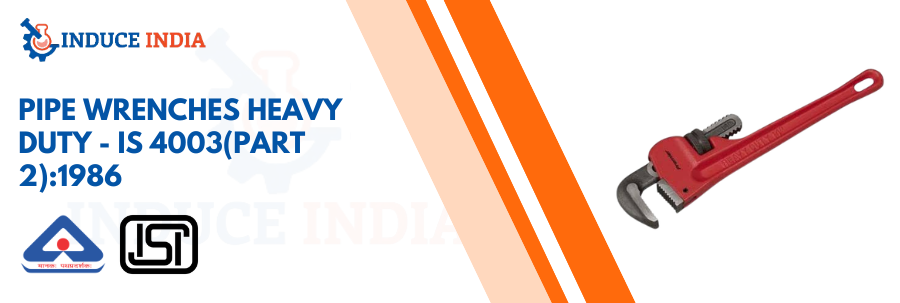
A common pipe wrench is all right for ordinary plumbing and maintenance jobs. Then head outdoors to a heavy industrial site like an oil and gas pipeline works, a power plant, a shipyard or a big building site, and things are very different. The pipes to be worked on are larger, heavier and much more resistant to turning/loosening. In such applications, a standard pipe wrench would not last long with the forces that are at play.
Heavy-duty pipe wrenches are where they come in handy. The tools are constructed of higher-strength materials and greater dimensions with deeper jaw teeth, specifically for the most rigorous applications in pipe fitting and maintenance in industrial applications. They are also applied in critical applications, so they must meet a well-specified quality criterion.
So, the Bureau of Indian Standards (BIS) came up with a solution in the form of Indian Standard (IS 4003) (Part 2):1986 – Indian Standard for heavy-duty pipe wrenches. We at Induce India assist the manufacturers, importers, and industrial sector in understanding and adhering to this standard. This blog will elaborate on what it entails and why it is important for the heavy-duty tools industry in India.
What is the ‘Heavy Duty’ in the description of a Pipe Wrench?
The heavy-duty classification is no marketing term; it’s a true category. There are some important differences between a heavy-duty pipe wrench and a standard purpose pipe wrench.
It is made of better quality steel and much stronger alloys that are able to take a lot more torque without bending or cracking. It’s bigger and can be used for much bigger pipes. The jaw teeth are deeper and stronger to make sure that the hold is tight, even if great effort is used. The adjustment mechanism has also been strengthened to withstand the much greater loads that operate in an industrial application.
What Is IS 4003 (Part 2):1986?
Indian Standard IS 4003 (Part 2):1986 was published by BIS, which specifies the requirements for heavy-duty pipe wrenches for use in industry. Part 1 of IS 4003 is for general-purpose pipe wrenches, while Part 2 is for the heavier, tougher variety that can only be used in industrial applications.
The standard lays down the requirement for materials, dimensions, jaw design, surface finish, mechanical performance and testing that every heavy-duty pipe wrench should have before it is used in India.
Key Requirements Under IS 4003 (Part 2):1986
Heavy Duty Pipe Wrenches: The standard calls for the use of pipe wrenches made with the proper grade of steel that is strong, tough and more wear-resistant. These wrenches have higher material requirements than other general-purpose wrenches, which directly reflect the higher forces that these wrenches need to withstand without any hazard to the industrial operation.
There are standard sizes according to the overall length of the wrench as given in IS 4003 (Part 2): 1986 Dimensions and Size Range. Heavy-duty models are much bigger than general-purpose models and are intended for pipes of much larger diameters. The standard specifies the jaw opening capacity for each of the sizes to allow the tool to accommodate the widest range of pipe sizes found in industrial applications.
The serrated teeth along the jaw faces must be deeper, stronger and more exactly formed than the serrated teeth of a simple wrench. They are defined in the standard by their geometry and their positioning so that they can provide a certain non-slip grip even during very high torque when working on large pipes. Low-quality teeth on a heavy-duty wrench may lead to serious slipping circumstances in crucial situations.
Surface Finish and Quality: All heavy-duty pipe wrenches must be sound and have no surface cracks, voids, sharp edges or other defects that would compromise the strength or safety of the wrench. The proper surface finish will also help to prevent rust and corrosion on the wrench – particularly in industrial settings where tools are exposed to moisture, oils and chemicals constantly.
Strength of the adjustment mechanism: A heavy-duty wrench’s movable jaw adjustment system should be considerably stronger than a general-purpose wrench. The adjusting nut and sliding jaw assembly should operate freely without any jamming, move smoothly, and not move excessively or fail when under heavy load.
Torque and load testing: Heavy-duty pipe wrenches have to undergo a rigorous torque test for each size. The wrench shall be capable of withstanding a certain high load without permanent bending, cracking, jaw slip or part failure. This test directly verifies that the tool can perform in real industrial conditions.
Marking Requirements: All conforming heavy-duty pipe wrenches are to be marked with the manufacturer’s name or trademark and the size of the pipe wrench with 100% traceability and accountability across the supply chain.
Why IS 4003 (Part 2):1986 Matters?
The compliance with this standard and BIS certification is an indication that your tools have been verified to be of a quality standard at the national level for manufacturers. It instils confidence in your customers, helps to secure large industrial contracts and shields your business from liability if your tools break.
The importer should check that the heavy-duty pipe wrenches conform to IS 4003 (Part 2):1986 before it is introduced in the Indian market. If the product is not compliant, it can be rejected and result in severe financial penalties that have the potential to adversely impact business operations.
How can India help?
We at Induce India make the BIS compliance process simple for heavy-duty tool manufacturers and importers. From start to finish, our experts can assist you in understanding all of the requirements of IS 4003 (Part 2):1986, create comprehensive technical documentation, arrange for product testing at BIS-approved laboratories and help you through the certification process effectively and economically.
Conclusion
Heavy-duty pipe wrenches are devices that are needed in industrial activities on an everyday basis. They are built to a standard, as per IS 4003 (Part 2):1986, which is commensurate with those requirements, i.e. they are strong, safe and durable. This standard is not optional, whether you are making, importing or purchasing these tools.