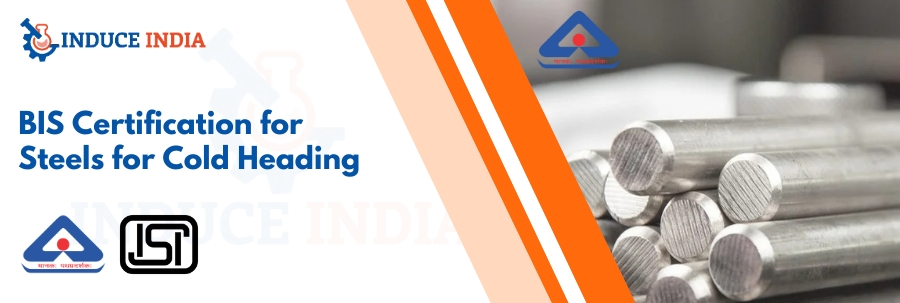
Cold heading steels are also important in the production of fasteners as bolts, screws, rivets, pins, and other precision elements. High pressure and deformation of these steels at room temperature imply that the quality of such steels, their strength, and consistency should be beyond being doubtful. Any minor sacrifice in the material properties can cause failure of the application in the crucial systems such as automotive, construction, machinery, and electrical components. This is the reason why BIS Certification is necessary for steels that are destined to be used in cold heading. It makes sure that all batches of steel supplied for such processes fulfil the safety, strength, as well as chemical requirements established in the Indian Standards.
We assist manufacturers and importers in making the correct call at Induce India and assist them in sailing through this certification process with utmost comfort and ease. In case you are manufacturing these steels in the country or you are importing them, BIS certification confirms that your product is in reverence, reputed, and fit to the Indian society.
What is BIS Certification on Steels for Cold Heading?
The Bureau of Indian Standards (BIS) controls the quality and safety of different materials used in the production process, such as steels to be utilised in cold forging and heading. Cold heading steels have to incorporate the appropriate chemical composition, mechanical properties, quality of the surface and microstructure that allows them to resist the heavy pressure of forming without cracking or deforming. The certification of BIS guarantees the satisfactory performance and structural properties of such materials as per the provisions of the concerned Indian Standard.
Since these steels are to be applied in high-stress environments, BIS certification becomes an indication that the product is reliable, consistent and safe to be used in industrial applications.
Applicable BIS Standard in Steels used in Cold Heading
Steels used in cold heading are classified under the IS 1570 or similar Indian Standards, which detail classification and quality requirements of those grades of steel used in cold forming operations. The standards outline the ranges of chemical composition, allowable impurities in it, mechanical properties and the technical conditions of delivery. They also establish testing methods, including tensile tests, hardness tests, as well as metallurgical tests.
With BIS testing, manufacturers are able to ensure that the steel can withstand extreme deformation and does not crack off, besides the necessary metallurgical accuracy demanded to manufacture fasteners and precision components.
BIS Certification on the Cold Heading Steels
Cold heading steels are transferred to high-performance parts that cannot give up when strained. BIS certification brings about standardisation and safety of the material at all levels. In the case of manufacturers, this certification enables the sale of the material as a legal sale in India and enhances the market reputation. To the end users, it gives them confidence that the steel is tested, safe and that it can be used in demanding applications.
Acceptance throughout the industry is another major factor. Automotive and infrastructure are just a few of the industries that do not tolerate steel materials unless they are certified by BIS to ensure that there is uniformity in the quality of the materials used.
Who Needs the BIS Certification for Steels in Cold Heading?
The BIS certification is required for manufacturers, suppliers, and importers of cold heading steels operating in India. This will apply to different parties within the supply chain, which include:
- Mill domestic manufacturers who manufacture steels intended for cold heading and cold forging.
- Indians who import steel coils, steel rods or bars to do cold heading operations.
- Companies that produce steels as fasteners or dexterous elements, OEMs and manufacturing companies that use them to make fasteners or precision parts.
- Steel products are sold under the company’s brands and by the distributors of steel.
In case the material is provided for cold heading purposes and finds the Indian market, it is mandatory to obtain the BIS certification.
Working of The BIS Certification Process
The certification process starts with the process of identifying the correct Indian Standard of the steel grade you are producing or importing. Subsequently, manufacturers are supposed to provide comprehensive paperwork associated with material makeup, production strategy, manufacturing place, quality management strategy, and brand information.
They should then test the steel samples in a recognised laboratory by BIS. Tests normally involve chemical testing, mechanical property testing, metallographic testing, hardness testing and surface testing. All the uploaded documents and results are in the BIS portal once the test is reported by the laboratory. The application is assessed by BIS officials, and in most instances, an inspection of the factory to ensure the ability to produce and quality systems is done.
When successful verification is done, BIS awards the certification and uses permission to implement the ISI Mark, meaning adherence to Indian Standards.
The Way Induce India Simplifies Certification Process
Manufacturers may find the BIS process to be a challenge, particularly because of the technical documentation, the complexities arising in testing and the steps involving the portal. Induce India offers a full range of services, including typical identification and paperwork as well as sample testing, filing of applications and final certification. Our staff would also make sure that your application is done according to the requirements and the procedure is finished in an efficient manner without wasting a lot of time. We provide you with a hassle-free and efficient certification process.
Conclusion
Steels used in cold heading should have BIS certification to ensure the safety of materials, consistent performance, and meet regulatory requirements. When these steels enter the very stressful part, then the exact quality standards cannot be negotiable. Having the help of the experts in Induce India, manufacturers and importers would find it easy to go through the entire registration process of BIS certification without failures to have their products comply with all requirements imposed by Indian Standards.
Whether you are manufacturing cold heading steel or importing, the Induce India is there to lead you in the certification process, being accurate, speedy and absolutely in the open.