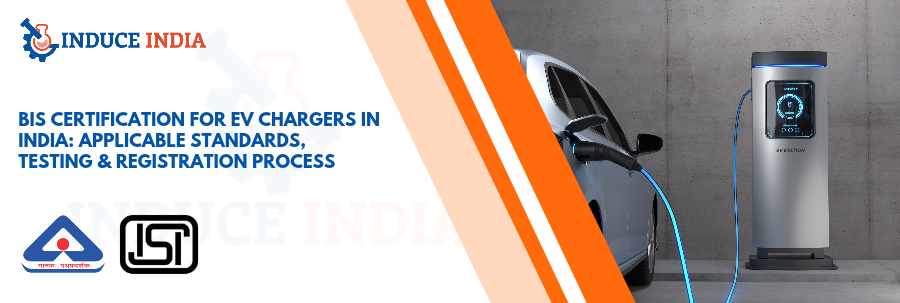
The electric vehicle (EV) industry in India is growing rapidly, increasing the demand for reliable and safe EV charging infrastructure. With more electric two-wheelers, cars, buses and commercial vehicles entering the market, the quality and safety of EV chargers have become important considerations.
BIS Certification for EV Chargers in India helps ensure that charging equipment complies with applicable Indian Standards and technical safety requirements. Manufacturers and businesses involved in supplying EV charging equipment must understand the relevant standards and regulatory requirements before entering the Indian market.
What is BIS Certification for EV Chargers?
The Bureau of Indian Standards (BIS) is India’s national standards body responsible for developing product standards and implementing conformity assessment schemes.
EV chargers, also known as Electric Vehicle Supply Equipment (EVSE), are designed to transfer electrical power from a supply source to an electric vehicle. Their safety, electrical performance and communication systems must meet the applicable technical requirements.
BIS standards for EV charging systems primarily focus on electrical safety, charging performance, connector compatibility, protection mechanisms and communication between the vehicle and charging equipment.
Who Needs BIS Certification for EV Chargers?
BIS compliance is important for businesses involved in manufacturing and supplying EV charging equipment in India. These include:
- Indian EV charger manufacturers.
- Foreign manufacturers exporting EV chargers to India.
- Companies selling EV chargers under their own brand.
- Importers and suppliers of charging equipment.
- Manufacturers of AC and DC charging systems.
The exact certification and regulatory requirements depend on the product category and applicable government notifications.
Applicable BIS Standards for EV Chargers in India
The IS 17017 series is the primary Indian Standard framework for electric vehicle conductive charging systems. Different parts cover general requirements, connectors, electrical safety, communication and charging equipment.
Important standards include:
- IS 17017 (Part 1): General requirements for electric vehicle conductive charging systems.
- IS 17017 (Part 2): Requirements for plugs, socket-outlets, vehicle connectors and vehicle inlets.
- IS 17017 (Part 21): Electromagnetic compatibility requirements.
- IS 17017 (Part 23): Requirements for DC electric vehicle supply equipment
- IS 17017 (Part 24): Digital communication requirements for DC charging systems.
- IS 17017 (Part 25): DC EV supply equipment with protection based on electrical separation.
The applicable standard depends on the charger type, power capacity, charging technology and product configuration.
Documents Required for BIS Certification
Manufacturers generally need to prepare business, manufacturing and technical documents before starting the certification or compliance process.
Common documents include company registration details, manufacturing unit address proof, product specifications, technical datasheets, circuit diagrams, product photographs, brand details, manufacturing process information and test reports.
Additional authorization letters, declarations and technical documents may be required depending on the applicant’s business structure and applicable BIS scheme.
Foreign manufacturers may also need to comply with the applicable Authorized Indian Representative requirements.
BIS Certification Process for EV Chargers
The process begins with identifying the applicable Indian Standard according to the EV charger category. Manufacturers must then prepare product specifications and the required technical documentation.
The charger is tested against applicable safety, electrical performance and communication requirements at an appropriately recognized testing laboratory. After successful testing, the applicant proceeds with the relevant BIS application or other applicable regulatory approval process.
BIS reviews the submitted information and may request additional clarification or documents. Once the applicable requirements are fulfilled, the relevant authorization can be processed.
Testing Requirements for EV Chargers
Testing is an important part of EV charger compliance. It helps verify that charging equipment operates safely and reliably under specified conditions.
Testing may cover electrical safety, insulation resistance, protection against electric shock, overload and short-circuit protection, electromagnetic compatibility (EMC), connector compatibility and vehicle-charger communication.
DC chargers may also require additional testing related to charging protocols and digital communication.
Common Mistakes to Avoid
Manufacturers may face compliance difficulties due to incorrect standard selection, incomplete technical documentation, unsuitable test reports or mismatched product specifications.
Another common mistake is assuming that every EV charger follows the same certification process. AC chargers, DC chargers and light electric vehicle charging equipment may have different technical and compliance requirements.
Checking the latest BIS standards and applicable government notifications before applying can help avoid unnecessary delays.
Benefits of BIS Compliance for EV Charger Manufacturers
Following applicable BIS standards helps manufacturers improve product safety, demonstrate technical compliance and build customer confidence. It also supports product reliability, brand credibility and business opportunities in India’s growing EV charging market.
Conclusion
BIS Certification for EV Chargers in India is an important part of ensuring safe and reliable electric vehicle charging infrastructure. Manufacturers and suppliers should understand the applicable IS 17017 standards, complete the required product testing and follow the relevant certification or regulatory procedures.
Induce India provides consultancy support for BIS certification, technical documentation and product compliance requirements. Contact our team to understand the applicable requirements for your EV charging products and get professional assistance with the compliance process.